Introduction
Where are we going, and why?
How does the New York City Marathon temporarily hijack the city’s inequalities and turn its streets into a theater of psychological resilience?
Why this unit?
Every first Sunday of November, New York closes its streets, opens its bridges to runners and lines its avenues with more than a million spectators. For a few hours, the city of business and speed becomes a public stage where bankers and bus drivers cheer the same strangers. Is this a moment of genuine unity, or a beautiful illusion that disappears the next morning?
You will travel from the four loops of Central Park in 1970 to the record race of 2026, follow the course bridge by bridge, watch the mayor of New York hand out water to runners, and finally write your own argued article.
Your road map
At the end of this unit, you will be able to: tell the history of a major public event, comment on real data, understand a short video report, dramatize what you say with emphatic inversion, interview someone and write an argued article at B2 level.
My end-of-lesson weather check
Take two minutes for yourself. Your answers stay private: they are only kept on this device, the page sends nothing and nobody else can see them. If you want, you can show them to your teacher.
Session 1: Fifty Years, Five Boroughs
Discover how a small race in a park became the biggest marathon in the world.
Recap
Before we start: what do you already know? Answer quickly, in English.
- What are the five boroughs of New York City?
- How long is a marathon, in kilometers or in miles?
- Name one famous park in New York City.
Answer key
- Manhattan, Brooklyn, Queens, the Bronx and Staten Island.
- 42.195 kilometers, or 26.2 miles.
- Central Park, for example (also Prospect Park in Brooklyn, Flushing Meadows Corona Park in Queens...).
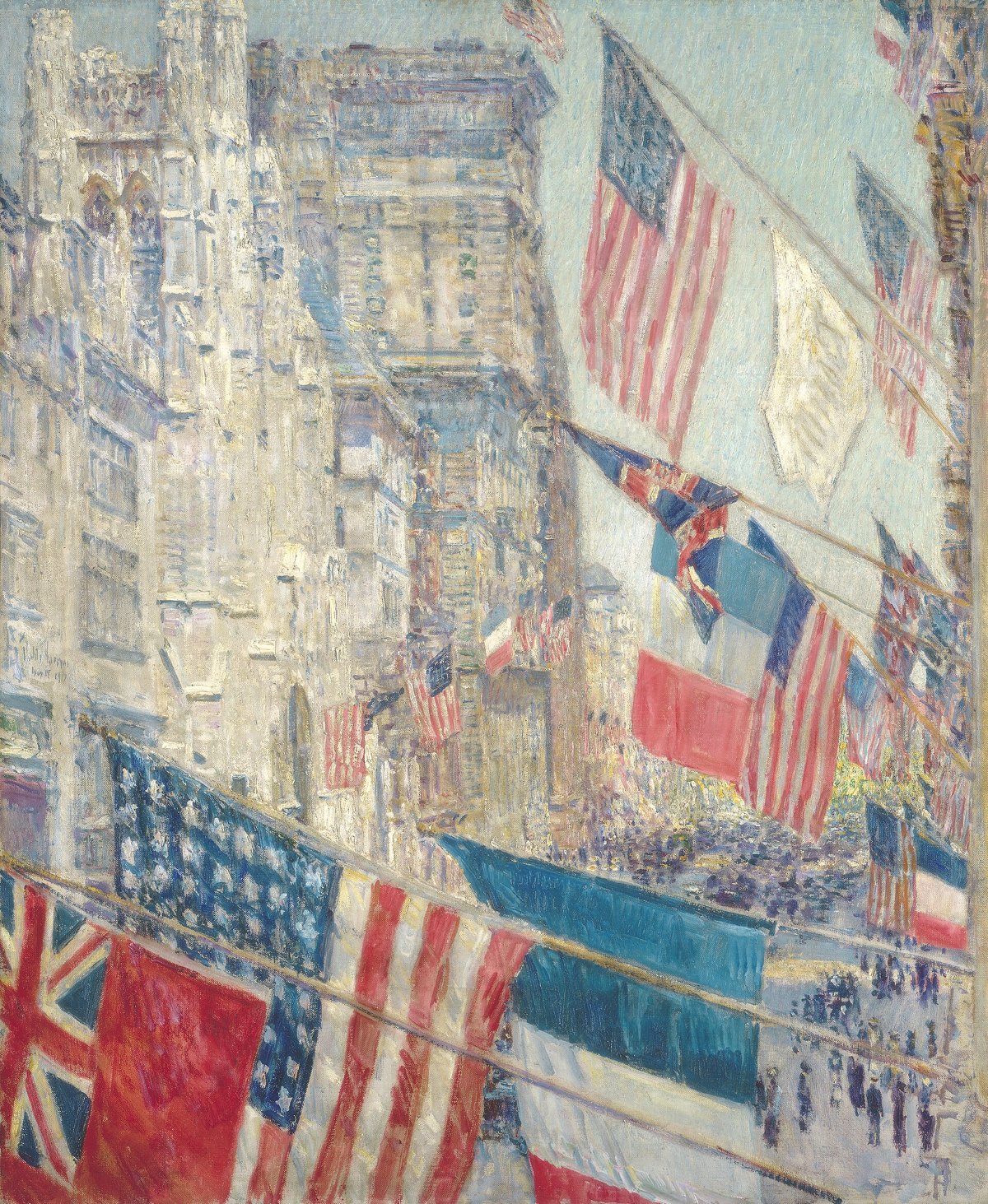
Look at the painting 10 min
Look at the painting at the top of the page and read its reference. Where are we? What fills the street, and what fills the sky? What kind of event do you think the crowd is waiting for?
- The painting depicts… It was painted in…, during…
- In the foreground / In the background, we can see…
- The crowd seems to…, which suggests that…
- The street is no longer a place for traffic: it has become…
Answer key
It is Fifth Avenue in Manhattan, in May 1917, a few weeks after the United States entered the First World War. Flags of the United States, Britain and France hang over the street; a dense crowd fills the avenue. The street has become a public stage for a shared event: this is exactly what the marathon does every November.
Read: from four loops to five boroughs 20 min
On a September morning in 1970, 127 runners, 126 men and one woman, lined up outside Tavern on the Green, in Central Park. The entry fee was one dollar. The course was simple: one trip around the park’s 1.7-mile lower loop, then four full loops of the park. Only 55 runners finished. The winner, Gary Muhrcke, was a New York City firefighter. The only woman, Nina Kuscsik, had to stop after 14 miles because she was ill.
In 1976, the year of the Bicentennial, the city was going through a severe financial crisis. A runner and political campaigner, George Spitz, had a bold idea: a marathon through all five boroughs. Manhattan Borough President Percy Sutton supported it, and the race director Fred Lebow turned it into a citywide celebration. That year, 2,090 entrants ran from Staten Island to Central Park.
Fifty years later, on 1 November 2026, the five-borough course celebrated its anniversary. According to New York Road Runners (NYRR), 61,529 runners started and 61,146 finished, from 153 countries: the largest marathon ever, for the third year in a row. More than a million spectators line the streets every year.
Check you understand
- Describe the first race in 1970: where, how many runners, what course?
- Why was 1976 a symbolic year, for the country and for the city?
- Who supported the idea of a five-borough race?
- Find three figures for the 2026 race and say what they refer to.
- In your own words: how did the race change its relationship with the city?
Answer key
- In Central Park, outside Tavern on the Green; 127 starters (126 men, one woman); one lower loop of 1.7 miles then four full loops of the park; 55 finishers.
- It was the Bicentennial of the United States (1776, 1976), and New York was in a severe financial crisis: the race was a way to celebrate and unite the city.
- George Spitz had the idea; Percy Sutton, Manhattan Borough President, supported it; Fred Lebow organized it.
- 61,529 starters, 61,146 finishers, 153 countries (and more than a million spectators).
- It left the closed space of the park and took over the streets of the whole city: it went from a race in the city to a race of the city.
Sources: NYRR, “NYRR in the 1970s: A Decade of Firsts”; NYC Parks, “New York City Marathon”; Central Park Conservancy; The New Yorker, “The First Five-Borough New York City Marathon”; NYRR press release, 2 November 2026; World Marathon Majors (spectators).
Read the data 15 min
Comment on the chart orally, for one minute. Compare, give proportions, interpret.
- The number of finishers rose from… in 1970 to… in 2026.
- That is more than … times as many as…
- Between 2024 and 2026, the race gained about… finishers.
- What strikes me is that…
Answer key
From 55 finishers in 1970 to 61,146 in 2026: more than 1,100 times as many. Between 2024 and 2026, the race gained about 5,500 finishers. The 2026 figure is provisional (as of race day, according to NYRR).
Homework
Learn the key dates and figures of the reading text. Then write five sentences about the history of the race, using five different time markers from this list: formerly, once, up to now, over the past fifty years, from now on.
My end-of-lesson weather check
Take two minutes for yourself. Your answers stay private: they are only kept on this device, the page sends nothing and nobody else can see them. If you want, you can show them to your teacher.
Session 2: Bridges, Silence and the Wall of Sound
Follow the course mile by mile and dramatize it with emphatic inversion.
Recap
Last session: from four loops to five boroughs.
- How many runners started the first race in 1970, and where?
- What happened to the course in 1976?
- How many runners finished in 2026?
Answer key
- 127 runners, in Central Park.
- It went through all five boroughs, for the Bicentennial.
- 61,146 (provisional figure, NYRR).
The course, mile by mile 15 min
Read the course and find the places where the crowd disappears and where it explodes.
- Mile 1Verrazzano-Narrows Bridge, Staten Island: the start, and the highest point of the course.
- Miles 2 to 12Brooklyn: the longest part of the race, through many different neighborhoods.
- HalfwayThe Pulaski Bridge takes runners into Queens, to Long Island City.
- Miles 15 to 16The lower level of the Queensboro Bridge, a long climb into Manhattan. Spectators are not allowed on the bridges of the course.
- Miles 16 to 19First Avenue, Manhattan: huge crowds wait for the runners as they come off the bridge.
- Mile 20The Willis Avenue Bridge takes runners into the Bronx, then the Madison Avenue Bridge brings them back to Manhattan.
- Miles 22 to 24Fifth Avenue, from Harlem along the east side of Central Park, a long gentle climb.
- FinishCentral Park, where the race was born in 1970.
Runners often speak of hitting the wall: the moment, late in a marathon, often around mile 20, when the body suddenly seems empty. In New York, this is roughly where the course enters the Bronx.
- Where is the course silent? Why?
- Where does the noise come back? How would you feel as a runner?
- Which borough do runners reach around mile 20, and what may happen to them there?
Answer key
- On the bridges, especially the Queensboro Bridge (miles 15 to 16): spectators are not allowed on the bridges.
- On First Avenue, as soon as runners come off the Queensboro Bridge: a wall of sound after the silence, a psychological boost.
- The Bronx: many runners hit the wall there.
Sources: NYRR, official 2026 course map; NYRR spectator guidelines, as reported by New York City Wave (October 2026).
Grammar: emphatic inversion (advanced emphasis) 25 min
The rule
To dramatize what you say, you can start a sentence with a negative adverb (Never, Seldom, Rarely) or a restrictive expression (Not only, No sooner, Only when, Under no circumstances, Hardly). Then the order of the subject and the auxiliary is inverted, as in a question.
Negative / restrictive adverb + auxiliary + subject + verb
| Standard sentence | With inversion (B2) |
|---|---|
| New York rarely sees such unity. | Rarely does New York see such overwhelming unity among its diverse neighborhoods. |
| Runners face physical exhaustion and they must also conquer psychological walls. | Not only do runners face physical exhaustion, but they must also conquer psychological walls. |
| I had never seen so many people in the street. | Never had I seen so many people in the street. |
Watch out. No auxiliary in the sentence? Add do, does or did, as in a question: Rarely does New York see…. With Only when and No sooner… than, the inversion is in the main clause: Only when they reach mile 15 do they realize…
Grammar in context: rewrite each sentence with an emphatic inversion
- The runners realize how brutal the Queensboro Bridge is only when they reach mile 15.
- A sports event has seldom modified the socio-economic boundaries of a city so deeply.
- Spectators are not allowed on the bridges under any circumstances.
- The runners had just left the bridge when the roar of First Avenue hit them.
- The race crosses five bridges and it also visits all five boroughs.
- I have never felt such energy in a crowd.
Answer key
- Only when they reach mile 15 do the runners realize how brutal the Queensboro Bridge is.
- Seldom has a sports event modified the socio-economic boundaries of a city so deeply.
- Under no circumstances are spectators allowed on the bridges.
- No sooner had the runners left the bridge than the roar of First Avenue hit them. / Hardly had the runners left the bridge when the roar of First Avenue hit them.
- Not only does the race cross five bridges, but it also visits all five boroughs.
- Never have I felt such energy in a crowd.
Comment on the course 10 min
In pairs, comment on the course and the chart of Session 1 orally. Each sentence must contain an emphatic inversion.
- Not only is the Queensboro Bridge closed to spectators, but it is also…
- No sooner do runners leave the bridge than…
- Never before had the race attracted…
- Only when they reach Central Park do runners…
Answer key
Possible answers: Not only is the Queensboro Bridge closed to spectators, but it is also a long climb. No sooner do runners leave the bridge than they hear the roar of First Avenue. Never before had a marathon had as many finishers as in 2026. Only when they reach Central Park do runners know they have made it.
Homework
Write a paragraph of about 80 words: you are a runner on the Queensboro Bridge. Describe the silence, then the noise of First Avenue. Use at least two emphatic inversions.
My end-of-lesson weather check
Take two minutes for yourself. Your answers stay private: they are only kept on this device, the page sends nothing and nobody else can see them. If you want, you can show them to your teacher.
Session 3: The Mayor at the Water Station
Understand a short video report and explain a public gesture.
Recap
Last session: the course and emphatic inversion.
- Why is the Queensboro Bridge so silent?
- Rewrite with an inversion: Runners rarely forget First Avenue.
- Complete: No sooner had the race started ______ the crowd began to cheer.
Answer key
- Spectators are not allowed on the bridges of the course.
- Rarely do runners forget First Avenue.
- than
Before you watch 5 min
Zohran Mamdani has been the mayor of New York City since 1 January 2026. Before he was elected, he ran the marathon himself, in 2022 and in 2024, according to the press. On Sunday 1 November 2026, he did not run. Look at the first image of the video: what is he wearing? What do you think he is doing there?
- He is wearing… which suggests that…
- I suppose he is there to…
- It is unusual for a mayor to…
Watch the video 20 min
First viewing (0:00 to 0:22)
- What is the mayor wearing, and why is this surprising?
- What does he give the runners? What else does he do?
- How do the runners react? Give two examples.
- Read the caption on the screen: who is the message for?
Second viewing (0:23 to 0:40)
- The mayor says the name of a runner. What does he wish her?
- What news does the runner give him? Where will it take place?
- Why does the mayor say “I’m sorry”? How does she answer?
Answer key
First viewing.
- A bright green volunteer vest over a dark suit and tie, and a cap: he looks like one of the race volunteers, not like a politician on a stage.
- Cups of water. He also cheers the runners on and gives them high-fives.
- Some runners slow down or turn around, smile, high-five him; some stop to talk to him or film him.
- For every New Yorker running the marathon: “Let’s go!”
Second viewing.
- He wishes her a great race (“Have a great race, Maddie”).
- She is getting married, in Central Park; she says her letter (her invitation) to him got lost in the mail.
- Because he did not answer her letter, which never reached him; she answers “I forgive you”, and he wishes her an amazing wedding in advance.
Public space, private moment 15 min
The video carries the words “Mayor Zohran Kwame Mamdani”: it was first posted by the mayor himself, then shared by news websites.
- Is the street a public or a private space on Marathon Sunday? Justify.
- Why might a mayor choose to stand at a water station rather than in an official stand?
- A video like this one spreads very fast on social networks. Is it a sincere gesture, a communication strategy, or both? Give arguments for each side.
- On the one hand…; on the other hand…
- Not only does the gesture…, but it also…
- Unless we know…, we cannot say for sure that…
Answer key
Open answers. Expected ideas: the street is closed to traffic and becomes a shared public space where private stories (a wedding, a personal challenge) are told aloud; standing among volunteers makes the mayor equal to ordinary New Yorkers; the video is posted by his own team, so it is also political communication, but the gesture is real and useful to runners. Both can be true.
Mediation 5 min
Your French-speaking friend saw the video with the sound off. Explain to him or her, in French, in about one minute: who the man is, where and when the scene takes place, what he does, and why people found the gesture so likeable.
Homework
Watch the video again at home. Write a short news report of about 100 words for your school website: “The Mayor at the Water Station”. Answer the questions who, what, where, when and why, and use one emphatic inversion.
My end-of-lesson weather check
Take two minutes for yourself. Your answers stay private: they are only kept on this device, the page sends nothing and nobody else can see them. If you want, you can show them to your teacher.
Session 4: The 5 Boroughs Voice
Expand your vocabulary and interview a runner on the course.
Recap
Last session: the mayor at the water station.
- Where and when was the video filmed?
- Give two things the mayor does in the video.
- Why can we say the video is both a sincere gesture and communication?
Answer key
- In Long Island City, Queens, near the halfway point of the race, on Sunday 1 November 2026.
- He hands out cups of water, cheers the runners on, gives high-fives (and talks with a runner).
- The gesture is real and useful to runners, but the video was posted by the mayor’s own team and spread on social networks.
Expanding your vocabulary 20 min
Urban disruptions
| Word or phrase | Meaning |
|---|---|
| to hijack the streets | to take control of the streets for another purpose |
| to bypass boundaries | to go around the limits that usually separate people or places |
| a socio-economic divide | a gap between rich and poor groups |
| gentrified enclaves | neighborhoods transformed by richer newcomers |
| urban tapestry | the rich mix of people and places in a city |
| to intermingle | to mix with other people (BO, B2) |
Physical and mental grit
| Word or phrase | Meaning |
|---|---|
| to hit the wall | to suddenly run out of energy, late in a race |
| sheer willpower | pure determination |
| to endure | to suffer something difficult for a long time |
| to disintegrate | to fall apart |
| a psychological boost | something that gives you new mental energy |
Crowd dynamics
| Word or phrase | Meaning |
|---|---|
| deafening cheers | shouts so loud that you cannot hear anything else |
| an emotional fuel | what gives you the emotional energy to go on |
| to echo | to be repeated as a sound bouncing back |
| solidarity | support between people who share a goal |
| a collective trance | a state where a whole crowd seems carried away |
Use the words: complete the sentences
- After the silence of the bridge, the ______ of First Avenue gave the runners ______.
- At mile 20, many runners ______: only ______ keeps them going.
- For one day, the race ______ that usually separate neighborhoods.
- Rich and poor New Yorkers ______ on the sidewalks, in a moment of ______.
Answer key
- deafening cheers / a psychological boost
- hit the wall / sheer willpower
- bypasses the boundaries
- intermingle / solidarity
Odd one out
- deafening cheers / solidarity / to echo / sheer willpower
- to hit the wall / to endure / to disintegrate / urban tapestry
Answer key
- sheer willpower: the others belong to crowd dynamics.
- urban tapestry: the others describe physical and mental effort.
Speaking drill: the audio-guide hack 30 min
In pairs. Student A is an undercover journalist or an urban sociologist posted at a strategic point of the course: where runners come back into Manhattan from the Bronx and start the long climb of Fifth Avenue towards Central Park. Student B is a runner close to exhaustion.
Goal: in 1 minute 30 seconds, the journalist interviews the runner about the contrast between the neighborhoods crossed and the effect of the crowd on his or her mind. You must use at least one emphatic inversion and three words from the vocabulary lists. Then swap roles.
- Journalist: Tell me, what went through your mind on the Queensboro Bridge?
- Journalist: Did you notice any difference between the neighborhoods?
- Runner: Never have I heard such deafening cheers…
- Runner: Not only did I hit the wall in the Bronx, but…
Assessment grid (B2)
| Criterion | Not yet | B1+ | B2 | Points |
|---|---|---|---|---|
| Interaction (asking, reacting, following up) | Questions read from notes, few reactions | Questions and some spontaneous follow-ups | Natural interview, relaunches the conversation, reacts to the answers | / 6 |
| Language (inversion, lexis) | Inversion absent or incorrect, little lexis of the unit | One correct inversion, three words of the unit | Several correct inversions, rich and precise lexis | / 6 |
| Content (contrast between neighborhoods, effect of the crowd) | Few ideas | Relevant ideas | Detailed, nuanced ideas, with facts of the unit | / 4 |
| Pronunciation and fluency | Hesitant, hard to follow | Generally clear | Clear, expressive intonation (emphasis) | / 4 |
| Total | / 20 |
Homework
Learn the three vocabulary lists. Record your part of the interview on your phone (one minute) and listen to it: check your inversions and your intonation.
My end-of-lesson weather check
Take two minutes for yourself. Your answers stay private: they are only kept on this device, the page sends nothing and nobody else can see them. If you want, you can show them to your teacher.
Session 5: Genuine Unity or a 24-Hour Illusion?
Debate, then prepare an argued article.
Recap
Last session: the 5 Boroughs Voice.
- What does to hit the wall mean?
- Give two words of crowd dynamics.
- Rewrite with an inversion: I have rarely felt so tired.
Answer key
- To suddenly run out of energy, late in a race.
- Deafening cheers, an emotional fuel, to echo, solidarity, a collective trance.
- Rarely have I felt so tired.
Debate in groups of five 30 min
Does the marathon really bring New Yorkers together, or is it a beautiful illusion that lasts one day? Two students defend each side; the fifth student is the reporter: he or she notes the arguments and sums up the debate for the class.
| Genuine unity | A 24-hour illusion |
|---|---|
| The race crosses all five boroughs and every kind of neighborhood. | The next day, the barricades are gone and the inequalities are back. |
| Spectators cheer for strangers of every origin; volunteers give their time. | Entry fees and travel costs mean not everyone can run. |
| The mayor stands among volunteers, like any New Yorker. | A viral video is also a communication tool for a politician. |
- I see your point, but…
- That may be true, yet…
- Not only does the race…, but it also…
- Wouldn’t it be surprising if…?
- All the more so as…
Reporter: sum up the two positions in one minute, without giving your own opinion.
Method: the argued article 20 min
- A catchy title and an introduction that presents the debate.
- Paragraph 1: the arguments for genuine unity, with one fact from the unit.
- Paragraph 2: the limits, with one fact from the unit.
- Conclusion: your nuanced opinion.
Useful connectors (B2): subsequently, although, unless, all the more so, whereas, nevertheless, consequently.
Homework
Write the plan of an argued article on the question of the debate, with two facts from the unit and two emphatic inversions. Revise Sessions 1 to 5 for the final assessment.
My end-of-lesson weather check
Take two minutes for yourself. Your answers stay private: they are only kept on this device, the page sends nothing and nobody else can see them. If you want, you can show them to your teacher.
Session 6: Final Assessment (B2)
Show what you have learned: reading comprehension and argued writing.
Recap
Before the test: a quick check.
- Give the two key dates of the history of the course.
- Where did the mayor hand out water in 2026?
- Give the structure of emphatic inversion.
Answer key
- 1970 (four loops of Central Park) and 1976 (five boroughs).
- In Long Island City, Queens, near the halfway point.
- Negative or restrictive adverb + auxiliary + subject + verb.
Part 1: reading comprehension (10 points) 30 min
A text written for this class
This text was written for this unit and is inspired by the facts we have studied. It is not a real essay and its author is not a real psychologist. “Collective emotional refueling” is an image invented for the text, not a scientific term.
For 364 days a year, New York City is an uncompromising grid governed by business and speed. Wealth shapes geography; invisible walls separate the busy towers of Manhattan from many streets of the outer boroughs. Yet, on Marathon Sunday, this layout is spectacularly hijacked. More than a million spectators line the asphalt, offering what we might call “collective emotional refueling”. Suddenly, the banker from Wall Street and the bus driver from the Bronx scream the same encouragement at the same strangers. Never before have these social worlds stood so close, shoulder to shoulder. However, this unity is ephemeral. No sooner has the last runner crossed the finish line in Central Park than the barricades are removed, the streets swept, and the ruthless economic architecture of the metropolis instantly reinstalled.
- Socio-spatial analysis. How does the author contrast the daily reality of New York with the specific atmosphere of Marathon Sunday? (3 pts)
- The concept of hijacking. In what way can the marathon be considered a political or social disruption rather than just a race? (3 pts)
- Linguistic analysis. Identify the two instances of emphatic inversion in the text. Translate them into French and explain how they reinforce the author’s argument about the intensity of the event. (4 pts)
Expected answers and marking
- Daily reality: a rigid grid ruled by business and speed, where wealth shapes geography and invisible walls separate Manhattan from the outer boroughs. Marathon Sunday: the layout is hijacked, a million spectators line the streets, people from opposite social worlds cheer side by side.
- The race takes over the streets, which normally serve traffic and business; it crosses the boundaries between rich and poor areas and puts different social groups in the same place, with the same emotion. It is a temporary disruption of the social order, and the text stresses that it does not last.
- “Never before have these social worlds stood so close” : « Jamais auparavant ces mondes sociaux ne s’étaient trouvés si proches ». “No sooner has the last runner crossed the finish line… than the barricades are removed” : « À peine le dernier coureur a-t-il franchi la ligne d’arrivée… que les barrières sont retirées ». The first inversion stresses how exceptional the unity is; the second stresses how fast it disappears. Together, they dramatize the contrast at the heart of the argument.
Part 2: written expression (10 points) 25 min
Write an argued text of about 250 words on one of the two subjects.
Subject A, critical article. You are a sports columnist for The New York Times. Write an article titled “The NYC Marathon: Genuine Social Unity or a 24-Hour Capitalist Illusion?”.
Subject B, interior monologue. Write the interior monologue of a runner hitting “the wall” at mile 20 in the Bronx. Focus on the psychological battle, the impact of the crowd’s screams and the changing urban landscape around you. Use emphatic inversions.
Assessment grid
| Criterion | Not yet | B1+ | B2 | Points |
|---|---|---|---|---|
| Task and content | Off topic or very short | On topic, some relevant ideas | Clear point of view, developed and illustrated with facts of the unit | / 4 |
| Organization | Little structure | Paragraphs and simple connectors | Coherent argument, B2 connectors | / 2 |
| Language | Frequent errors that block meaning | Some errors, meaning clear | Varied structures, emphatic inversions, precise lexis | / 4 |
| Total | / 10 |
Homework
Self-assessment: in three sentences, say what you can now do in English that you could not do before this unit. Use one emphatic inversion: Never before had I…
My end-of-lesson weather check
Take two minutes for yourself. Your answers stay private: they are only kept on this device, the page sends nothing and nobody else can see them. If you want, you can show them to your teacher.
Sources
All facts and figures of this unit come from these sources, checked on 4 November 2026.
Professeur
Pour le professeur
Séquence de terminale générale, LVA, niveau visé B2, construite sur votre modèle « Hijacking the Grid » : même problématique, même point de grammaire (inversion emphatique, avec ses exemples et l’exercice), même labo de lexique, même jeu de rôle et même évaluation de type B2. Le programme de terminale correspond au niveau B2 et contient explicitement l’inversion après adverbe restrictif ; les deux axes de votre modèle sont des axes de terminale.
Chaque séance s’ouvre sur un recap et se termine par des devoirs. Les réponses sont masquées ; le bouton « Teacher mode » les affiche toutes. Une version adaptée suit les mêmes séances.
Déroulé
| Séance | Contenu | Activités |
|---|---|---|
| 1 | Le tableau de Hassam ; l’histoire du tracé (1970, 1976, 2026) ; graphique des arrivants (données NYRR) | EOC, CE |
| 2 | Le parcours mille par mille ; l’inversion emphatique (règle, exemples, six phrases) ; commentaire oral | CE, EE, EOC |
| 3 | La vidéo du maire au ravitaillement ; espace public et réseaux sociaux ; médiation | CO, EOI, médiation |
| 4 | Expanding your vocabulary ; jeu de rôle « The Audio-Guide Hack » (1 min 30), grille B2 sur 20 | EOI |
| 5 | Débat « Genuine Unity or a 24-Hour Illusion? » avec rapporteur ; méthode de l’article argumenté | EOI, médiation, EE |
| 6 | Évaluation B2 : compréhension de l’écrit sur 10, expression écrite sur 10 | CE, EE |
La vidéo
The Independent, « Mamdani hands out water and cheers on runners at NYC Marathon », publiée le 2 novembre 2026, 40 secondes, intégrable. Début à 0:00. De 0:00 à 0:22 : le maire, gilet vert de bénévole sur son costume, tend des gobelets d’eau aux coureurs, les encourage et tape dans leurs mains ; bandeau « To every New Yorker running the marathon: LET’S GO ». De 0:23 à 0:40 : il souhaite bonne course à une coureuse, Maddie, qui lui annonce qu’elle se marie à Central Park ; elle plaisante sur sa lettre « perdue à la poste », il s’excuse, elle lui pardonne.
Précision : la scène ne se passe pas le long de Central Park, mais à Long Island City (Queens), près de la mi-course, le dimanche 1er novembre 2026 (ThePrint, MARCA, Times of India). Les images portent la mention « Mayor Zohran Kwame Mamdani » : elles viennent du compte du maire, reprises par la presse. Ce point sert l’axe 5 (parole sur les réseaux sociaux).
Faits et chiffres
Tous les chiffres viennent de sources officielles ou reconnues, vérifiées le 4 novembre 2026 (onglet Sources). Les chiffres 2026 (61 529 partants, 61 146 arrivants) sont ceux du communiqué NYRR du 2 novembre 2026, « au 1er novembre, sous réserve de vérification finale ». Le nombre de spectateurs retenu est celui des World Marathon Majors : plus d’un million.
Le graphique de votre modèle (chute d’allure sur le Queensboro Bridge) ne repose sur aucune donnée publique vérifiable : il est remplacé par un graphique réel des arrivants (1970, 2017, 2024, 2025, 2026). Le fait réel conservé : les spectateurs sont interdits sur les ponts du parcours.
Le texte de l’évaluation est présenté aux élèves comme un texte écrit pour la classe, et non comme un véritable essai ; l’expression « collective emotional refueling » y est donnée comme une image, pas comme un terme de psychologie. « Millions of spectators » est devenu « More than a million spectators », chiffre vérifié.
Le tableau
Childe Hassam, Allies Day, May 1917, 1917, huile sur toile, 92,7 × 76,8 cm, National Gallery of Art, Washington (1943.9.1). Domaine public, image en accès libre CC0 du musée. Fifth Avenue pavoisée et noire de monde : la rue devient une scène publique partagée, comme le jour du marathon.