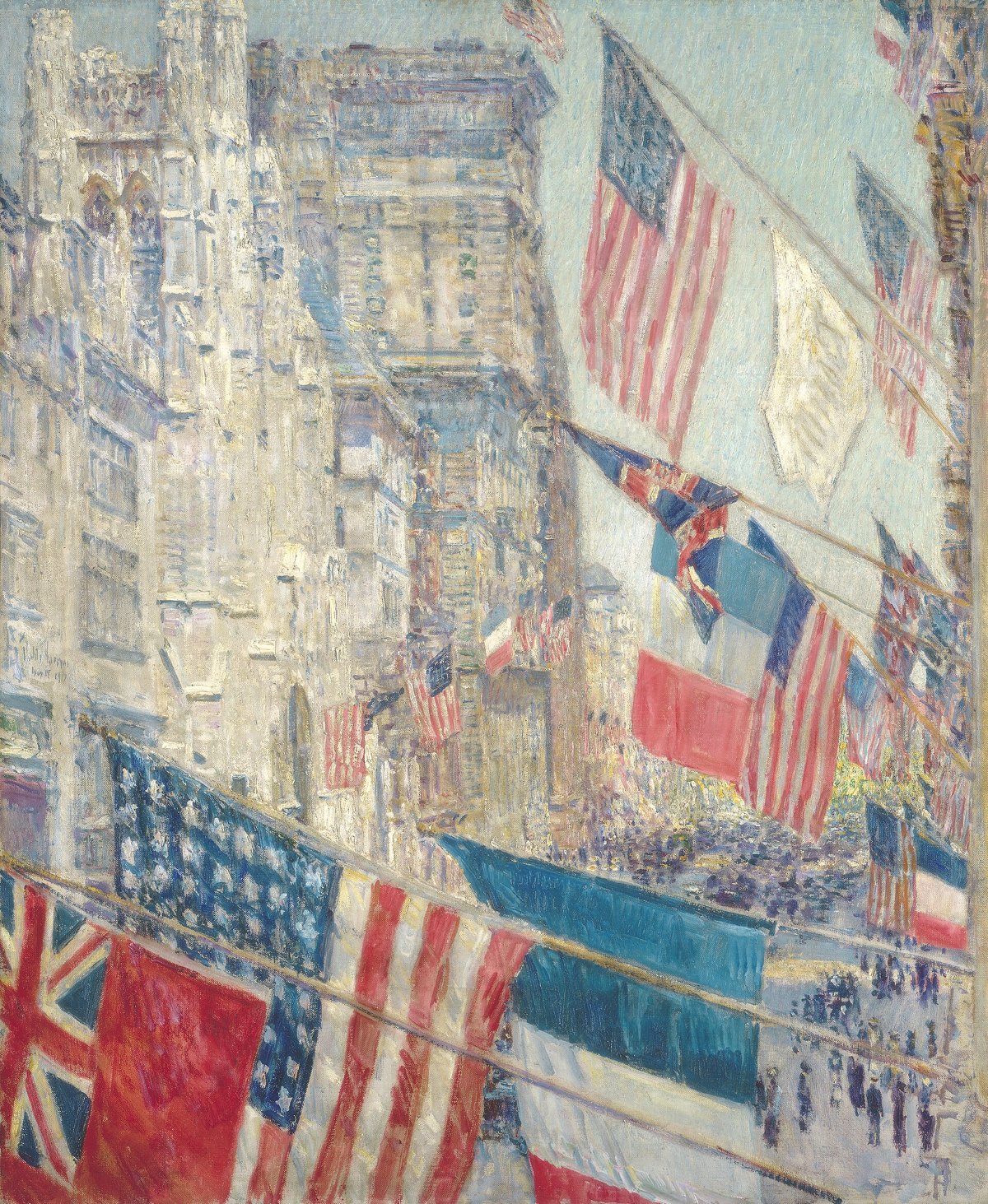
Start here
Does the marathon bring New York together, for one day?
How this version works
- Six sessions, like the class version.
- One step at a time.
- Click an answer: you see if it is right.
- Click Listen to hear the text.
- The answers are hidden: click to see them.
Your road map
Session 1: Fifty Years, Five Boroughs
Goal: tell the story of the race in a few dates.
Recap
What is the biggest park in Manhattan?
How long is a marathon?
Look at the painting
Step 1Look at the painting at the top of the page.
Step 2Read the first line under it.
Where is the scene?
What do you see above the street?
Read: the story of the race
Step 1Listen. Then read.
- 1970: the first race. It is in Central Park.
- 127 runners start. Only 55 finish.
- 1976: the race goes through the five boroughs.
- 2026: 61,146 runners finish. It is a world record.
- More than one million people watch in the streets.
Answer.
Where was the first race in 1970?
What happened in 1976?
Read the chart
Complete the sentence.
In 1970, runners finished. In 2026, runners finished.
55 61,146
Answer key
In 1970, 55 runners finished. In 2026, 61,146 runners finished.
Homework
Learn the three dates: 1970, 1976, 2026. Write one sentence for each date.
My end-of-lesson weather check
Take two minutes for yourself. Your answers stay private: they are only kept on this device, the page sends nothing and nobody else can see them. If you want, you can show them to your teacher.
Session 2: Bridges and Noise
Goal: follow the course and use “Never have I…”.
Recap
In 1970, the race was…
How many runners finished in 2026?
The course
Step 1Read the course, slowly.
- Mile 1Verrazzano-Narrows Bridge, Staten Island: the start, and the highest point of the course.
- Miles 2 to 12Brooklyn: the longest part of the race, through many different neighborhoods.
- HalfwayThe Pulaski Bridge takes runners into Queens, to Long Island City.
- Miles 15 to 16The lower level of the Queensboro Bridge, a long climb into Manhattan. Spectators are not allowed on the bridges of the course.
- Miles 16 to 19First Avenue, Manhattan: huge crowds wait for the runners as they come off the bridge.
- Mile 20The Willis Avenue Bridge takes runners into the Bronx, then the Madison Avenue Bridge brings them back to Manhattan.
- Miles 22 to 24Fifth Avenue, from Harlem along the east side of Central Park, a long gentle climb.
- FinishCentral Park, where the race was born in 1970.
Answer.
Where is it silent?
Why?
Grammar: emphatic inversion
The rule
Start with Never, Rarely or Not only.
Then: auxiliary + subject + verb.
Like a question.
| Normal | With inversion |
|---|---|
| I have never seen such a crowd. | Never have I seen such a crowd. |
| New York rarely sees such unity. | Rarely does New York see such unity. |
Choose the right sentence.
Never…
Rarely…
Complete. Use the word bank.
- Never I felt so tired.
- Rarely runners forget First Avenue.
- Not only the race cross five bridges, but it also visits five boroughs.
have do does
Answer key
- Never have I felt so tired.
- Rarely do runners forget First Avenue.
- Not only does the race cross five bridges, but it also visits five boroughs.
Homework
Write two sentences with an inversion: one with Never, one with Rarely.
My end-of-lesson weather check
Take two minutes for yourself. Your answers stay private: they are only kept on this device, the page sends nothing and nobody else can see them. If you want, you can show them to your teacher.
Session 3: The Mayor at the Water Station
Goal: understand a short video.
Recap
Complete: Never ___ I seen this.
Where is it silent on the course?
Before you watch
- The man in the video is Zohran Mamdani.
- He is the mayor of New York City.
- Date: Sunday 1 November 2026.
- Place: Long Island City, Queens, near the halfway point.
Watch the video
Watch from 0:00 to 0:22.
What is he wearing?
What does he give the runners?
What else does he do?
Watch from 0:23 to 0:40.
What is the runner’s news?
Your opinion
Step 1Choose and complete.
I think the gesture is because .
nice sincere political surprising
Explain in French
Step 1Tell a French friend, in French: who, where, what.
Homework
Write three sentences: who is the man, where is he, what does he do.
My end-of-lesson weather check
Take two minutes for yourself. Your answers stay private: they are only kept on this device, the page sends nothing and nobody else can see them. If you want, you can show them to your teacher.
Session 4: The 5 Boroughs Voice
Goal: learn ten words and do a short interview.
Recap
Who is Zohran Mamdani?
What does he give the runners?
Expanding your vocabulary
| Word | Meaning |
|---|---|
| to hit the wall | to have no more energy |
| sheer willpower | pure determination |
| to endure | to suffer for a long time |
| a psychological boost | new mental energy |
| deafening cheers | very, very loud shouts |
| solidarity | people help each other |
| to echo | a sound comes back |
| to hijack the streets | to take the streets for something else |
| a socio-economic divide | a gap between rich and poor |
| to intermingle | to mix with other people |
Choose the right word.
At mile 20, I have no more energy: I…
The crowd is very loud: …
Speaking: a short interview
Step 1In pairs. A is a journalist. B is a tired runner.
Step 2A asks two questions. B answers.
- A: How do you feel?
- A: What do you think of the crowd?
- B: Never have I been so tired!
- B: The cheers give me a psychological boost.
Use one inversion and two new words. Then swap.
Homework
Learn the ten words. Say your interview at home, aloud.
My end-of-lesson weather check
Take two minutes for yourself. Your answers stay private: they are only kept on this device, the page sends nothing and nobody else can see them. If you want, you can show them to your teacher.
Session 5: Unity or Illusion?
Goal: give your opinion with one argument.
Recap
“To hit the wall” means…
“Deafening cheers” are…
Two opinions
| Real unity | Only for one day |
|---|---|
| The race visits all five boroughs. | The next day, everything is normal again. |
| People cheer for strangers. | Not everyone can pay to run. |
Choose one opinion.
Step 2Complete.
I think the marathon is because .
real unity an illusion
Plan your text
- Title.
- Idea 1 + one fact.
- Idea 2 + one fact.
- Your opinion.
Homework
Write your plan: two ideas and two facts.
My end-of-lesson weather check
Take two minutes for yourself. Your answers stay private: they are only kept on this device, the page sends nothing and nobody else can see them. If you want, you can show them to your teacher.
Session 6: Final Assessment
Goal: show what you have learned.
Recap
When did the race go through the five boroughs?
Rarely ___ runners forget First Avenue.
Part 1: reading (10 points)
A text written for this class. It is not a real essay.
- For 364 days a year, New York is a city of business and speed.
- But on Marathon Sunday, the streets change.
- More than a million people cheer the runners.
- Rich and poor stand side by side.
- Never before have they been so close.
- But the next day, everything is normal again.
- What is New York like on a normal day? (2 pts)
- What changes on Marathon Sunday? (3 pts)
- Does the unity last? Justify. (2 pts)
- Copy the sentence with an inversion. (3 pts)
Expected answers
- A city of business and speed.
- The streets change; more than a million people cheer; rich and poor stand side by side.
- No: the next day, everything is normal again.
- Never before have they been so close.
Part 2: writing (10 points)
Step 1Choose A or B. Write about 120 words.
A. Article: is the marathon real unity or an illusion?
B. You are a runner at mile 20 in the Bronx. You hit the wall. Say what you feel.
- I think that…
- On the one hand… On the other hand…
- Never have I…
- The crowd gives me…
Homework
Say what you can do now in English: three sentences.
My end-of-lesson weather check
Take two minutes for yourself. Your answers stay private: they are only kept on this device, the page sends nothing and nobody else can see them. If you want, you can show them to your teacher.
Sources
All facts and figures of this unit come from these sources, checked on 4 November 2026.
Professeur
Pour le professeur
Séquence de terminale générale, LVA, niveau visé B2, construite sur votre modèle « Hijacking the Grid » : même problématique, même point de grammaire (inversion emphatique, avec ses exemples et l’exercice), même labo de lexique, même jeu de rôle et même évaluation de type B2. Le programme de terminale correspond au niveau B2 et contient explicitement l’inversion après adverbe restrictif ; les deux axes de votre modèle sont des axes de terminale.
Chaque séance s’ouvre sur un recap et se termine par des devoirs. Les réponses sont masquées ; le bouton « Teacher mode » les affiche toutes. Une version adaptée suit les mêmes séances.
Déroulé
| Séance | Contenu | Activités |
|---|---|---|
| 1 | Le tableau de Hassam ; l’histoire du tracé (1970, 1976, 2026) ; graphique des arrivants (données NYRR) | EOC, CE |
| 2 | Le parcours mille par mille ; l’inversion emphatique (règle, exemples, six phrases) ; commentaire oral | CE, EE, EOC |
| 3 | La vidéo du maire au ravitaillement ; espace public et réseaux sociaux ; médiation | CO, EOI, médiation |
| 4 | Expanding your vocabulary ; jeu de rôle « The Audio-Guide Hack » (1 min 30), grille B2 sur 20 | EOI |
| 5 | Débat « Genuine Unity or a 24-Hour Illusion? » avec rapporteur ; méthode de l’article argumenté | EOI, médiation, EE |
| 6 | Évaluation B2 : compréhension de l’écrit sur 10, expression écrite sur 10 | CE, EE |
La vidéo
The Independent, « Mamdani hands out water and cheers on runners at NYC Marathon », publiée le 2 novembre 2026, 40 secondes, intégrable. Début à 0:00. De 0:00 à 0:22 : le maire, gilet vert de bénévole sur son costume, tend des gobelets d’eau aux coureurs, les encourage et tape dans leurs mains ; bandeau « To every New Yorker running the marathon: LET’S GO ». De 0:23 à 0:40 : il souhaite bonne course à une coureuse, Maddie, qui lui annonce qu’elle se marie à Central Park ; elle plaisante sur sa lettre « perdue à la poste », il s’excuse, elle lui pardonne.
Précision : la scène ne se passe pas le long de Central Park, mais à Long Island City (Queens), près de la mi-course, le dimanche 1er novembre 2026 (ThePrint, MARCA, Times of India). Les images portent la mention « Mayor Zohran Kwame Mamdani » : elles viennent du compte du maire, reprises par la presse. Ce point sert l’axe 5 (parole sur les réseaux sociaux).
Faits et chiffres
Tous les chiffres viennent de sources officielles ou reconnues, vérifiées le 4 novembre 2026 (onglet Sources). Les chiffres 2026 (61 529 partants, 61 146 arrivants) sont ceux du communiqué NYRR du 2 novembre 2026, « au 1er novembre, sous réserve de vérification finale ». Le nombre de spectateurs retenu est celui des World Marathon Majors : plus d’un million.
Le graphique de votre modèle (chute d’allure sur le Queensboro Bridge) ne repose sur aucune donnée publique vérifiable : il est remplacé par un graphique réel des arrivants (1970, 2017, 2024, 2025, 2026). Le fait réel conservé : les spectateurs sont interdits sur les ponts du parcours.
Le texte de l’évaluation est présenté aux élèves comme un texte écrit pour la classe, et non comme un véritable essai ; l’expression « collective emotional refueling » y est donnée comme une image, pas comme un terme de psychologie. « Millions of spectators » est devenu « More than a million spectators », chiffre vérifié.
Le tableau
Childe Hassam, Allies Day, May 1917, 1917, huile sur toile, 92,7 × 76,8 cm, National Gallery of Art, Washington (1943.9.1). Domaine public, image en accès libre CC0 du musée. Fifth Avenue pavoisée et noire de monde : la rue devient une scène publique partagée, comme le jour du marathon.